


Dorata Di Parma | Onion Seed
$6.00—$211.22gst incl.

Delicious long day Italian storage onion
Dorata di Parma is a classic northern Italian long day storage onion. It produces rounded, golden yellow bulbs averaging 250–300 g. Known for its fantastic storage capability and rich spicy flavour, it is a reliable choice for growers targeting both fresh market and storage markets.
As a long day type, Dorata di Parma requires 14–16 hours of daylight to bulb, making it best suited to latitudes above 40°S. Ideally adapted to Tasmania and southern Victoria, Dorata di Parma thrives under the long summer days of these southern regions. It is generally unsuited to onion production zones further north, where day length is too short for proper bulbing.
Sow in trays from July to August and transplant in September, allowing plants to size up before bulbing begins in the long days of summer. Harvest can be expected in January to February. After curing, bulbs hold well in storage, extending supply well into autumn and winter.
- Long day type
- Northern Italian variety
- 120 days to maturity
- Golden yellow colour
- Rounded bulb shape
- 250–300g each in size
- Best suited to latitudes >40°S (Tasmania, far-south Victoria)
- Long storage, good shelf life
Quantity
Categories
Tags
Plant Family
Harvest Season
Brand Catalogue
Growing Information
Dorata Di Parma | Onion Seed
SCIENTIFIC NAME: Allium cepa
CULTURE: Onions require full sun and fertile, well-drained soil with a pH of 6.0-7.0. Sandy loam soils are ideal; raised beds or raised rows are recommended for heavier soils to promote soil drainage.
DIRECT SEEDING: In October or early November, or as soon as the soil can be prepared in early spring, sow in a 5cm wide band, about 2 seeds/25mm, 6-12mm deep, use an X-24 or MJ-24 Jang seedwheel rows 30-45cm apart. Thin to 3-5cm apart for highest yields in fertile soil. Thin to 7-10cm apart for larger onions.
TRANSPLANTING: In short-season areas, sow seeds indoors in flats in late August to mid-September. Broadcast 12mm apart and cover 6mm. Tops may be clipped to 12cm tall. Transplant to the garden 10cm apart, or sow 5 seeds in each cell of 25-38mm diameter plug trays, thinning to 3 per cell. Transplant each cell 15cm apart. For Paperpot Transplanters use the 2.8mm seed plate and LP303-15, 15cm chain pots
CULTIVATION: Keep onions well weeded with shallow cultivation.
WATER: Onions are shallow rooted and grow best with at least 25mm per week of rain or irrigation, especially during the bulbing phase.
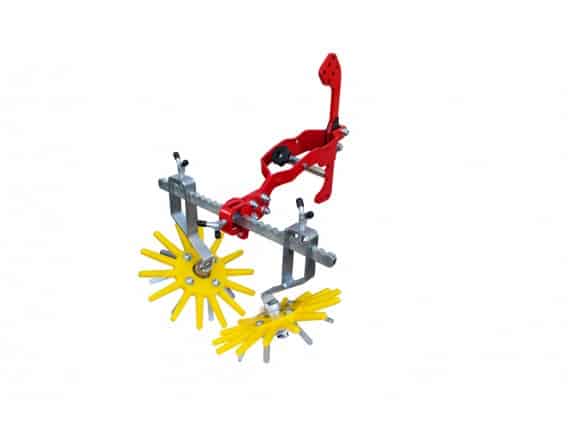
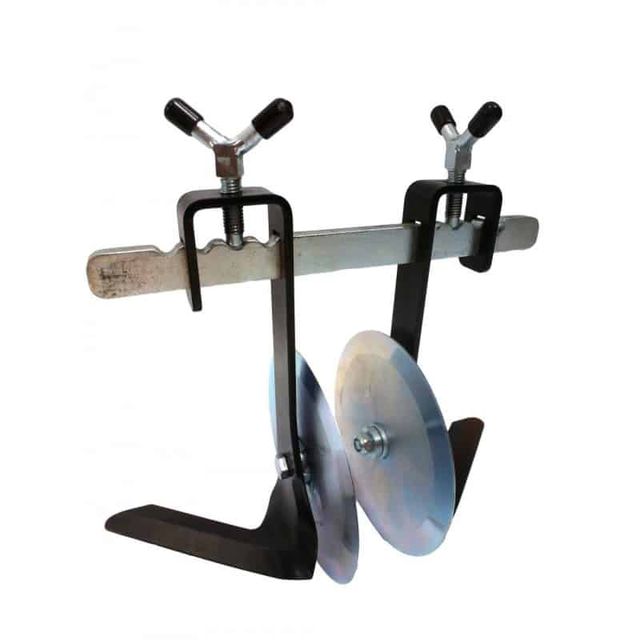
WEEDING: Prepare the area with stale bedding, cultivating and flame weeding. Follow up after planting with a wide stirrup or collinear hoe for shallow row weeding.
DISEASES: Adequate air circulation and crop rotation aids in reducing the risk of foliar disease
HARVEST: When necks become soft and tops are falling over, pull and sun-cure at least 2-7 days, depending on weather. Move to a protected location to finish drying.
STORAGE: When dry, clip off tops and roots and store in onion bags or shallow boxes at near freezing and 65-70% humidity.
DAY LENGTH: Onion bulbing is triggered by day length, and maximum day length during the growing season increases from northern to southern Australian areas. Short-day onions are grown at higher latitudes in the northern states, while intermediate and long-day onions are grown at lower latitudes.
DAYS TO MATURITY: From direct seeding; subtract 10-15 days if transplants are used.
AVG. DIRECT SEEDING RATE: 30g/8m, 1000 seeds/15m, 5k/83m, 25k/400m, 580,000 seeds/acre, 60 seeds/linear metre, in rows 45cm apart.
TRANSPLANTS: Avg. 30g/5,000 plants, 100g/16,000
SIZED SEEDS: Standard on all varieties.
SEED SPECS: SEEDS/500grams: 100,000-130-000 (avg. 112,000).